Zobrazujú sa príspevky s označením squats. Zobraziť všetky príspevky

utorok 25. augusta 2020

Warming up, stretching, warming up and cooling down - are they really important? | Steroids4U.eu

 Warming up, stretching, warming up and cooling down - are they really important?


Stretching or warming up are the basis of every training plan, which is unfortunately often forgotten. At the same time, it plays a really important role in building muscle, reducing muscle mass and eliminating injuries. Read what stretching techniques we know and what benefits they hide.


The difference between stretching, heating and cooling

The difference between stretching and warming up before training lies in their purpose. The goal of stretching is to increase flexibility and range of joints. However, when warming up, it is important to increase body temperature and blood flow to the muscles. Both of these techniques are usually performed before exercise, but you can do stretching even after training along with cooling. However, all three forms of exercise are part of one complex, which is warming up.

Warming up

Warming up before training is an important prevention of injuries. Proper warming revitalizes the cardiovascular system by increasing body temperature and blood flow to the muscles. Warming up also prepares your muscles for overload during training. If the muscles are sufficiently warmed up during warm-up, this will increase the range of motion and reduce the risk of injury during exercise. Examples of good warm-up are aerobic exercises, such as cycling, walking or jogging, which you should do for at least 5 to 10 minutes.

Cooling

After exercise, your heart rate is increased and your muscles are tense. The purpose of cooling is therefore to return the heart rhythm to normal and prevent muscle formation. An example of cooling after training is, for example, fast walking with gradual deceleration. Cooling down is very important for endurance athletes, such as marathon runners, because it helps them regulate the flow of blood in the body after a long period of physical activity.

Stretching

Stretching, stretching the muscles can be done before or after training. Its main purpose before training is to improve the extent of the joints and reduce the risk of injury during exercise. You can try stretching the whole body, or just focus on a specific group of muscles that you plan to exercise afterwards. After training, however, stretching performs a completely different function and its purpose is to prevent the onset of muscle. Stretching can also be very relaxing, both physically and mentally.

Benefits of stretching and warming up muscles

Improves performance

Inevitably the best benefit of stretching or warming up your muscles is their impact on your performance. It helps to improve in three effective ways:

Improves blood flow - heating or stretching for about 10 minutes has been shown to improve blood flow and open blood capillaries, which have been associated with improved subsequent physical performance.
Improves oxygen function - oxygen is released into the muscles faster at higher temperatures. If you indulge in stretching before training, you will warm up your muscles, which will be ready to give the best possible performance during training. If you miss stretching, it can take a long time for oxygen to be released into your muscles during your workout, which can have a negative effect on your performance.
Accelerates muscle contractions - warming up muscles before training raises body temperature. This results in better nerve transmission and muscle metabolism. As a result, your muscles will act faster and more effectively on all stimuli during and after training.

It serves as an accident prevention

With an effective and consistent warm-up before training, you relax the joints, increase their range and improve blood flow to the muscles. All of these aspects are extremely important in preventing injuries. The more your muscles are stiff and bloodless, the higher the risk of injury during exercise.

It removes heat from the body

Activation of heat removal mechanisms from the body contributes to effective cooling of muscles, which helps prevent overheating and subsequent overtraining. This benefit is especially important for demanding aerobic activity, such as running or cycling.

It balances the production of hormones

During physical activity, the body increases the production of various hormones, including cortisol and adrenaline. They are directly responsible for regulating energy production and your physical performance. If you miss a warm-up before a workout, these hormones may be activated late and have no effect. On the contrary, you can activate them already during warm-up, which will give your body enough energy during training.

Advantages of cooling

Supports fast recovery after training

After intense and strenuous training, lactic acid accumulates in the muscles. It is an organic substance that is formed during the breakdown of glucose in muscles. At rest, the body forms only a small amount and is transported to the liver, where it is converted back to glucose. However, during increased physical activity, more glucose is formed, which also creates a higher level of lactic acid, which the liver cannot process. Therefore, it is stored in the muscles and causes cramps, muscle pain or even muscle fever. It is the cooling phase after training that can help the process of eliminating lactic acid from the muscles. This helps to regenerate faster and prevents muscle formation. Creatine supplementation, which also supplies the muscles with energy, has proven to be another great means of reducing lactic acid production during training.

Reduces delayed onset muscle pain (DOMS)

Delayed Onset Muscle Soreness (DOMS) usually begins a day or two after training. The pain you experience during or immediately after a workout is another type of muscle pain, also called acute muscle pain. This is due to the above-mentioned reason for the formation of lactic acid and is accompanied by pain immediately after training. 

DOMS can cause any exercise that creates small microscopic cracks in the muscle fibers. The body responds to this damage by increasing inflammation, which can lead to a delayed onset of muscle soreness. Symptoms of DOMS or muscle muscle to look out for may include:

to touch sensitive muscles
reduced range of motion due to pain and stiffness when moving
swelling of the affected muscles
muscle fatigue
short-term loss of muscle strength

Research has shown that effective prevention of DOMS is cooling after training with warm-up and muscle stretching, or massage of individual stressed muscle areas.

Types of stretching

Just as there are different types of training, there are several forms of stretching. When warming up, you can focus on static, dynamic, but also ballistic stretching. Let's see what the difference is between them.

Static stretching

This is the most common type of stretching. His technique is to stretch a muscle, or group of muscles, to its farthest point and then maintain that position. This type of stretching is considered to be the safest way to stretch muscles. It gives muscles and connective tissues enough time to relax.

Static stretching is usually done before strength training, by stretching the muscles you are going to exercise. However, many experts consider this type of stretching to be much less effective than dynamic stretching, as dynamic warm-up increases the range of motion significantly.

Dynamic stretching

Unlike static stretching, dynamic stretching is a popular way to warm up muscles before aerobic exercise. Dynamic warm-up consists in maximally warming up the muscles by repeating the movement several times in a row. The purpose of dynamic stretching is therefore to improve flexibility before performing any sport, running, cycling or other aerobic activity. An example of dynamic stretching is, for example, a sprinter who takes excessively long steps before running to set the maximum range of motion for the upcoming power.

Ballistic stretching

Many exercisers confuse this type of stretching with dynamic stretching. However, there is a significant difference between them. The basis of the dynamic warm-up is formed by regular repeated and intentionally coordinated movements. However, ballistic stretching uses irregular, jerky, mostly aerobic movements, such as intense jumping or sprinting. At the same time, the limit of the maximum range of motion should be exceeded during ballistic stretching. However, it is important to note that this type of stretching is more prone to injury and should only be performed by experienced athletes.

Passive stretching

Depending on the type of force acting, stretching can be divided into passive and active. Passive stretching occurs when an external force helps to reach the maximum point of range. This can come through gravity, another person, or a tensioning device, such as strengthening rubbers or suspended strengthening systems. The point is that the muscle you want to stretch is not primarily stressed, so you can relax while stretching. Passive stretching is extremely effective in relieving muscle cramps that are treated for injuries.


Active stretching

Active stretching is characterized by the use of your own strength to maintain a stretching position. So this is the opposite of passive stretching. An example is lifting your foot off the ground while lying down, using only the power of your feet to keep it in the air. For passive stretching, you would use arm support, for example, to keep your foot in the air. Active stretching is therefore much more strenuous, but more effective in building muscle and flexibility.

Myofascial release

A massage roller or other massage device is used for this type of stretching. Its application to the muscles relieves myofascial tension and improves flexibility in the fascia. The fascia is a specialized system of connective tissue that unites the whole body. It affects bones, muscles, joints, nerves and is also found in the brain and spinal cord. Therefore, it is important to take care of the fascial system and stimulate it regularly. The tension at one fascial point also affects more distant places, as it is a closely interconnected system. Therefore, if you feel tension in the calf, believe that this tension is not only in the calf, but also in other parts of the body.

How to do proper and effective stretching

Duration of stretching - several studies suggest that stretching or cooling one muscle part should take approximately 30 to 60 seconds.

The number of repetitions - depends on several factors, such as your physical condition, age or gender. However, you should not overdo it with stretching and indulge in as many repetitions as you can. It is important to listen to your body.
Breathing - this will help you relax properly. You should inhale slowly before stretching a muscle and exhale slowly as you stretch it. Exhalation should not be enhanced, but natural.
When to Do Stretching - To achieve optimal results and prevent injury, stretching, warming up the muscles and cooling them should be part of every your training plan.
Types of stretching according to muscle parts
You already understand the theory of stretching and warming up muscles, it's time to start exercising. What should such stretching look like? It all depends on which game you decide to practice. However, it is optimal to focus on stretching the whole body.

Stretching the whole body

The advantage of stretching the whole body is that no matter what workout you are going to do, every muscle will be properly stretched. The basis is to start from the head and gradually move to the feet, while not forgetting any muscle part.

Stretching of individual muscle parts

An increasingly popular technique, especially for bodybuilders or fitness lovers, is to focus stretching only on certain muscle areas. Specifically for those that you are going to strain after stretching. So look at what the stretching of the muscles of individual parts of the body should look like.

Feet and ankles - many athletes, especially bodybuilders, forget to exercise this muscle part. These are muscles directly connected to the calf muscles or hamstrings. They are mainly used for running, cycling, but also strength training during the deadlift. Therefore, if you do not stretch your feet and ankles properly, you may cause unpleasant injuries.

Calf - The calf muscles are also often underestimated during warm-up. At the same time, it is in the calf that most muscle cramps occur during exercise. A great exercise during warm-up is to stretch the calf while standing against the wall. Therefore, stand facing the wall, step forward with your right foot and leave the left one facing outwards so that you are in a slight forward bend. Push the heel of the back outstretched leg towards the ground until you feel your calf tighten. Of course, there are many more exercises for the calf muscles, so you can always liven up your warm-up.

Thighs - here it is necessary to focus on stretching the front and back thigh muscles. When stretching the front muscles of the thigh, the "standing leg pulls" exercise is effective. Stand on both ground with both feet and bend one leg so that your heel touches your sciatic muscles. Then grasp the heel with your hands and hold it in this position for at least 30 seconds. During this exercise, you should feel your front thigh muscles tense. Conversely, if you want to train your back thigh muscles or hamstrings, you need to focus on a different kind of exercise. Sit straight on the ground. Keep your back straight and try to touch your toes with your fingers. However, never bend your legs at the knees during this exercise, otherwise it will be ineffective.

Back - when warming up the back, it is necessary to start stretching the cervical spine. This is exactly what is involved in many, whether cardio or strength exercises. The basic type of warm-up is bowing of the head towards the front, back, left and right. After exercising the cervical spine, you will go downwards, to the lumbar part, which you will stretch with a forward bend and a full body. You can also use yoga positions when practicing the neck, cervical spine, but also the lower back.

Shoulders, triceps and biceps - The basis of the shoulder stretching exercise is to stretch your arm, bend it at the elbow and place it behind your head while holding it with the other hand. Of course, this is one of the easiest exercises, but if you have a strenuous shoulder workout in the gym, you should focus on a more comprehensive warm-up. The same is true for triceps and biceps, to which you should devote separate time when stretching.

Breakdown of the training plan in steps:

muscle warming by short aerobic activity
stretching of the whole body or a selected group of muscles
the training itself
stretching the whole body after training
cooling

Keep in mind, however, that no results will be obtained without the correct execution of individual exercises. So if you decide to include stretching and warm-up in your training plan, which you should definitely do, study the proper exercise technique carefully.

nedeľa 12. júla 2020

There are two types of people who go to exercise. Those who train and those who look like that. What group do you belong to? | Steroids4U.eu

There are two types of people who go to exercise. Those who train and those who look like that. What group do you belong to?


How is it possible that someone trains with results after a short time and someone does not succeed in the long run?
It is no coincidence that someone starts exercising and achieves visible results almost immediately. It is also no coincidence that someone trains for a long time without results. The results are determined by your work (training). Those with results really train, those without results just look like that.

What you will learn in this article:

* Why I consider training an absolute priority in changing the figure.

* Training and training process to achieve results.

* A group of trainers who actually train and have results.

* A group of trainers who actually (don't) train and have no results.

Most trainers can be divided into these two groups. My practice and the practice of a large group of coaches agree with this. Training as such is only one part of character change. For these needs, it doesn't matter if it's weight loss and fat burning or building and building muscle mass. Possibly improving fitness.

Why I consider training an absolute priority in changing the figure.

In this article, I focus "only" on training. This is for the following reasons:

Already the approach to the implementation of training determines with high probability other variables entering the "game",
In terms of body activity, this is the most challenging "thing"
"Pain" in training will teach you a lot,
From the point of view of muscle (organism) load, it is necessary to observe, learn and use findings,
Training as the only factor acts directly on the muscles (stimulating).


Training and training process to achieve results.

The training process is a multispectral matter. Another, the same set of factors influences him outside of training.

It is not expedient to name all the factors in the training and beyond, because it literally affects him absolutely everything. Starting with whether you were empty enough before training, whether you were uncomfortable with your partner or slept badly,…

Your settings resp. training preparation should therefore be conscientious (as far as possible). Because, this "training" setting affects not only the training itself but also its results. And you want results or not?

The training itself is a unique event where you continue to influence whether you achieve the results in the form of body shaping, fat burning, muscle growth, etc., or not.

The training and the training process with which you will achieve results should be based first on diligent work and then on a suitably chosen exercise program (training plan).

In practice, I met many people who trained really hard but did not have a well-set training plan. Improperly selected training plan can be changed immediately. Without diligent work, however, I did not come across any above-average results.

I dealt with this topic in a separate article Practicing and training is not the same. How to know the difference?

A group of trainers who really train and have results.

These are mainly hard working (coaching) people. As described above, training is influenced by many factors inside and outside the training itself. Diligent work resp. Honest and regular training is the foundation on which everything else can be built.

Honest training does not mean getting into exhaustion but actually doing the necessary (training) work.

This work is based on mental and physical nature.

The psychological nature of honest training means that the trainer is ready to perform and will perform it. It's a FEELING. The feeling of a well-prepared / practiced training within the hormonal balance can be as anabolic as the physical training itself.


The physical nature of honest training means that the trainer stimulates the muscles / body / CNS with a load. This specifically means that the muscle structures are damaged (because training damages the muscles). It is therefore their physical damage due to the fact that the muscles were adequately loaded (worked).

People achieving training results have the two essences fully (at least for the most part) settled.

Of course, the training process itself can still be improved. But in the overwhelming majority, these two (mentioned) essences are already decisive.

A group of trainers who actually (don't) train and have no results.

People who are not really training also demand results in many cases. Unless they practice for a purpose other than leisure, getting to know each other and the like.

The difference, however, is that they approach training as a necessary evil that needs to be done. For this reason, they very rarely push their physical boundaries.

Without a certain amount of enthusiasm and enthusiasm, it is complicated to adjust mentally and then exercise physically enough. Without sufficient load, there is no necessary muscle stimulation. Therefore, the muscles are not stimulated and there are no other stimuli (or subsequent ones).

The ability to actually start training and achieve results is mostly not in the strengthening of further training. The opportunity is to find a way / type of training that will be fun, consistent with the values ​​and opportunities that the individual requires and provides.

Strengthening into "standard" training if you don't like it is a way to create even more frustration than to achieve the desired results of body shaping and well-being.

Another disadvantage of getting stronger into training is in energy intensity. It is very (mentally) difficult to do something that you are not even a little happy about. The more with (greater) resistance you train. In the end, you give up or find a "different way" by choosing a more suitable type / training method.

štvrtok 9. apríla 2020

Arnold Schwarzenegger - training, diet and motivation of the bodybuilding legend | Steroids4U.eu

Arnold Schwarzenegger - training, diet and motivation of the bodybuilding legend

Many people cannot decide who they want to become in their future. But Arnold Schwarzenegger knew from a young age that he wanted to be a bodybuilder and not just that. He wanted to be the best. He adhered to this idea, worked on it and eventually achieved it. How did he do it all?

Arnold Schwarzenegger

The power of Arnold's vision


"I've always believed that you need a vision to be motivated or to work hard."

Arnold's vision was born in his early childhood when he first saw the world's heavyweight champions. He recalls, in particular, how Tommy Kono won the 1961 title. Universe. Watching these bodybuilders had an incredible impact on Arnold and began to develop his own vision.

At the age of 15, Arnold decided to start training as a real bodybuilder. "I started watching heroic, elaborate guys and I was reading the magazine he had in Reg Park's cover photo depicted as Hercules." Reg's life was written in the magazine and how Mr. Universe. It is this edition of the magazine that has become the path to Arnold's future success. “If at any time I felt lost in my life, that feeling was gone. Now I had the direction. I realized that I had a special ability that could not be trained. The ability to see things very clearly. ” Instead of seeing Reg Park on London, Arnold saw himself there. "I've seen hundreds of bodybuilders around me, holding a trophy and hearing everyone chant my name."

Arnold Schwarzenegger - training, diet, motivation

Arnold was motivated by a vision of victory more than anything else. “It was so strong that I didn't even need the discipline - it just dragged me to go to the gym every day. I knew that every training I had since had taken me one step closer to turning this beautiful vision into reality. My life took a single direction - Mr. Universe, training and typing. ”

In 20 years, Arnold reached his goal and became the youngest Mr. Universe in history. Instead of enjoying the glory and relaxing, Arnold decided to train even more. “I felt I was undoubtedly a new hope of bodybuilding. But I still didn't get where I wanted to go. Become Mr. The Universe is like winning the Golden Glove or the Boxing Olympics - it's great, but it's far from being the best boxer. ”

But Arnold didn't want to be just a great bodybuilder, he wanted to be the best. “I realized it would take me a while. In America, extraordinary bodybuilders like Serge Nubret and Dave Draper were more elaborate, more popular and more sophisticated to pose. ”

When Arnold was 21, he moved to America and people immediately began to notice him. “They whispered about me. They said this is the boy from Austria. He is the boy who is already making a deadlift with 317 kilograms. ” This confirmed Arnold that he had taken a challenging but correct step. “I barely understood. I couldn't watch news or read newspapers. I felt isolated from the outside world. I felt alone. Nevertheless, they greeted me with open arms. I got so much love and support from bodybuilders who didn't even know me. I will never forget it, it was something really special. ”

All bodybuilders long for perfection and Arnold was no exception. “I never felt I reached 100% of my potential. I think every bodybuilder feels that way. He wants to have bigger triceps, bigger thighs and more stomach. ” Arnold's successful bodybuilding career was built on continuous improvement and attempts to improve small physical details. Working on these details kept Arnold's hunger for victory and fueled his vision.


Arnold Schwarzenegger, Franco Columbu, training


“We took pictures like fanatics. Franco Columbu took pictures of me and I took pictures of him. We compared photos, observed improvements, and tried to find bottlenecks. With hard work you can achieve your goal and become successful. That's great for bodybuilding. If you are good at it and achieve your goals, you will be able to apply the same principles to anything else in your life. ”

Training according to Arnold Schwarzenegger
"The biggest mistake today in bodybuilding is that people don't include basic exercises in their workouts."

However, the basic exercises Arnold did not mean easy exercises. Many contemporary fitness centers are overcrowded with people sitting on machines, not at dumbbell stands. “When I go to the gym today, no young boy learns about moving overhead or pulling a big dumbbell to his chin straight from the floor. They all use machines. ”

Arnold Schwarzenegger, training, diet

However, Arnold does not insist on the inclusion of basic exercises because he longs to live in the past. It all comes from decades of his experience in bodybuilding and hard work, which Arnold said will not be replaced by fitness machines. “Get everything out of you, for every season. Don't spare yourself to the next. This is a mistake many people make. ” Arnold believes that every repetition and every series must be done with high intensity because it moves you closer to the goal.

 We chose a few of Arnold's favorite exercises to prepare you for Mr. Olympia. The fact that Arnold was awarded Mr. Olympia up to 7 times!

Exercises for the chest

“There are 3 chest exercises that you should always train. Bench press, incline bench press at different angles and dumbbell fly-flat presses (dumbbell flyes). ”

Arnold was known for the size and width of his chest. It is due to the possibility of extreme muscle tension when pulling with dumbbells lying on a flat bench (dumbbell flyes).

Arnold Schwarzenegger, exercises for the chests

“Exercising with a dumbbell lying on a flat bench is a workout that has worked to fully develop my pectoral muscles. Remember, it is important for your muscles to stretch and strengthen them. In this exercise, I tightened my arms as far as I could, and then returned to the original position to touch the dumbbells. You will not replace this exercise with any machine. ”

Back exercises

“I trained on my back with undershoes, big dumbbell leaning forward, one-handed dumbbell leaning forward, and specially modified two-handed dumbbell leaning forward. I relied on these exercises from the beginning to the end of my career. ”

If you already have oaths included in your workout plan, do them without supporting your chest. “There are many bodybuilders who have trouble working out the lower back. You need to relax your body and allow the lower back to keep the load straining. This will give you the right strength and develop a wide back. ”

Biceps and triceps exercises


Arnold trained all kinds of biceps strokes. One technique he used to shock biceps was that the first repetition began with 124 kilograms. On the second he lost weight and on the third repeat he lowered his weight even more. “That was the way I grew without ever putting the dumbbell down. I wanted to let my biceps know they had no idea what to expect. They will never get used to the method of my workouts because I always have a trick up my sleeve. ”

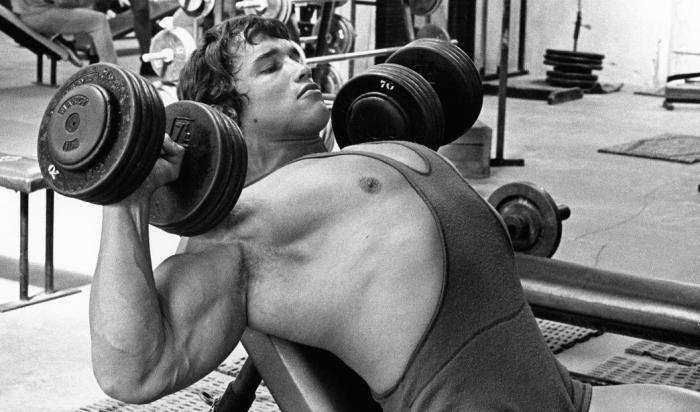
Arnold used a large barbell stroke to build a wide biceps. To isolate the biceps, he trained dumbbell strokes on an inclined bench and isolated biceps strokes. “Heavy-weight isolated biceps strokes were able to isolate the biceps, creating a“ spitz ”on the biceps. We used a lot of tight-grip pressure for the triceps. Later there were also different variants of triceps extensions. ”

Shoulder exercises

Arnold worked on his shoulders with the following exercises:

pressure with barbell press
behind-the-neck barbell press
lateral raises
presses with a big dumbbell in front of the head (military press)
dumbbell presses

“We've always been doing pressures with a two-handed dumbbell from behind the head and special presses with dumbbells that stretched the front deltoid from below and fully outlined it from above. Now this technique is called Arnold's pressures. ”

Thigh and leg exercises

“Drep is the most important exercise for creating large thighs. I did a squat with a dumbbell behind my head, a squat, a kick, a lunge, a one-leg deadlift, “good morning” exercises and a lot of tripping. ”

Exercises for belly

“The classic training we did to develop the abdomen was made up of lifting the legs in the lying position, lifting the legs in the trapeze vision, and sitting down. We believed that the 500 repetitions of the Romanian Sed-Leh really did work. ”

Arnold's variation of training before Mr. Olympia
In this variation of training, you exercise each muscle group twice a week. This training plan comes from the book The New Encyclopedia of Modern Bodybuilding, written by Arnold Schwarzenegger himself and Bill Dobbins.


Training split


Day 1: Chest and back


Day 2: Shoulders and hands


Day 3: Legs and lower back


Day 4: Chest and back


Day 5: Shoulders and hands


Day 6: Legs and lower back


Day 7: Rest

Arnold Schwarzenegger, training split


Protein matters!

Early in his bodybuilding career, Arnold knew that protein was the most important nutrient for muscle growth. “There has always been debate about how much protein the body really needs. I consumed one gram of protein for each kilogram of my weight. ”

Arnold weighed nearly 107 kilograms, which was a challenge for him to take 250 grams of protein a day. “It worked best for me when I had 5 meals a day. There are people who can work with three meals a day. For me, 5 meals were ideal because I was never a big one. I've always been happy with a medium-sized steak. Even if you gave me only a small 200 gram steak at the top of my career, I would be happy. ”

Arnold Schwarzenegger - diet plan

For breakfast, Arnold often had noodles, bacon, tomatoes and onions. "That's enough, but two hours after breakfast I was hungry again." Arnold never went far without a protein shaker to cover his daily doses of protein he needed for constant growth. “Whether I was sitting at a school in Santa Monica City College or working on a construction site, I always pulled a small plastic container full of milk and protein powder out of my bag. That was exactly the remaining 30 grams of protein I needed at that time. ”

An hour after the protein drink, Arnold went to do what he knew best - lifting weights at the gym. After training, he had lunch, usually steak and vegetables. Two hours after lunch, Arnold indulged in another protein sheikh. “I drank protein drinks twice a day to be able to take 250 grams of protein. However, you have to realize that we do not get all the nutrients we need, such as vitamins, minerals or protein itself, from ordinary foods. That's why we have nutritional supplements. No matter how healthy you eat, you will never get enough of the essential nutrients from ordinary foods. ” For dinner, Arnold usually enjoyed grilled chicken with brown rice, vegetables or salad with avocado, macadamia nuts and olive oil.

Arnold has left a huge mark on the bodybuilding world, as evidenced by the IFBB Arnold Sports Festival, also known as the Arnold Schwarzenegger Sports Festival. This event was founded in 1989 in Arnold's honor. It consists of classic bodybuilding (Arnold Classic), strongman competition (Arnold Strongman Classic) and fitness & bikini expa.

utorok 7. apríla 2020

Exercises for hamstrings - how to strengthen the rear thigh muscles? | Steroids4U.eu

Exercises for hamstrings - how to strengthen the rear thigh muscles?


Hamstrings are a muscle part that is often forgotten. We usually emphasize quadriceps and calf training, but the back thigh muscles seem less important to us. However, it should be remembered that neglecting any muscles has aesthetic and health consequences that you can avoid by rigorous training.

What are hamstrings?
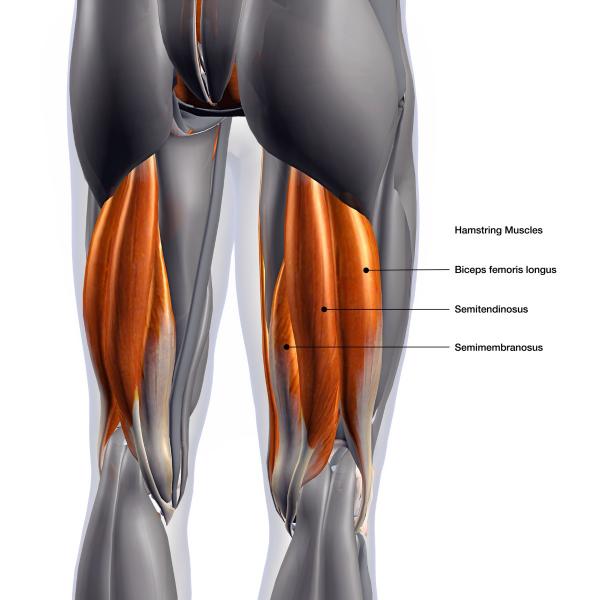
The rear thigh muscles cross the hip and knee joint, and are composed of three separate muscles - biceps femoris, semimembranosus and semitendinosus.

  1. Biceps femoris - is a muscle in the inner thigh that begins in the thigh area and ends at the knee. Allows flexion and rotation of the knee joint and extension in the hip joint.

  2. Semimembranosus - is the largest muscle between hamstrings, starting at the hip bone and ending at the back of the whistle. It allows flexing the knee, rotating the whistle and also extending the thigh muscle.

  3. Semitendinosus - is the longest hamstring muscle, located between the semimembranosus and the biceps femoris. It connects to the pelvic bone and ends at the whistle. It is responsible for whistle rotation, knee flexion and thigh extension.


https://www.steroids4u.eu

Best hamstring exercises

Hand on the heart, do you also practice hamstrings during leg training? The reason you should not forget them is not just the symmetry and appearance of your body. Weak hamstrings are one of the most common causes of injuries to athletes that occur in both men and women. In this article we will introduce you to 10 exercises that will give you strong and aesthetic hamstrings.


1. Romanian deadlift
Romanian deadlift is one of the most effective exercises for strengthening the rear thigh muscles. It is different from the classic deadlift, because the Romanian version almost does not bend at all. How to do it? Grasp the dumbbell approximately in the width of your shoulders with your hands pointing down naturally. Bend your knees slightly and bend as if to lay a dumbbell on the floor. Keep your back straight and be careful not to bend your knees too much, otherwise you are not exercising properly. As you move down, feel the pressure above your knees and thus in the hamstrings. Then return to the starting position by pulling the sitting muscles.

deadlift


2. Sumo deadlift
Sumo deadlift is another variant of deadlift that is designed to strengthen the rear thigh muscles. Approach the barbell so that it crosses the middle of the feet. Keep your legs wide, close to the wheels during this exercise. Bend your waist and grasp the dumbbell with both hands in the middle. Bend in the waist, point your gaze in front of you and hold your chest upright. Lift the barbell by attaching the hips and knees and hold with the hips facing the barbell, pushing the blades together. Then return to the starting position.

Sumo deadlift


3. Leg press
Sit in a leg press machine, place your feet on the platform, and hold your feet approximately the width of your shoulders. Release the safety lever and use the thigh muscles to push the weight until your legs are extended. However, never over knee during this exercise to avoid injury. When inhaling, slowly return to the starting position so that your knees and thighs are at a 90 degree angle.

Leg press

4. Stumbling seat
Set the desired weight and sit in the machine. Place your feet on the cylinder so that they touch it a few centimeters below the calf. For exhalation, push the cylinder down, under the thighs, and hold for 1 second in the final position. Then inhale and return to the starting position.

stumbling


5. Stumbling 
Choose a suitable weight, lie down on your stomach and grasp the handles with your hands. Place your feet under the cylinder so that they touch the cylinder a few centimeters below the calf. During the exhalation lift the cylinder and hold it in the final position for 1 second. Exhale and slowly return to the starting position. Make sure that you do not move your thighs when you lift the roller, and that you stay stable on the mat all the time.

https://www.steroids4u.eu


6. Good morning exercise
The main advantage of this exercise is that you do not need machines, only two-handed dumbbell. You start with a dumbbell on your shoulders, your back is reinforced all the time. Bend the knees slightly, push your butt forward and lean forward to 90 degrees. Then, inhale, return to the starting position. In addition to hamstrings in this exercise, you also strengthen the sitting muscles and weightlifters.

“Good morning”


7. Hyperextension
Hyperextension is a great exercise for hamstrings, but also the lower back and sitting muscles. Stand in the hyperextension machine with your feet firmly anchored. Cross your arms over your breasts or behind your head. Bend your waist and bend your torso downward as you exhale. Then, inhale, return to your starting position. Keep your head in line with the rest of the body throughout the movement and feel the pressure in the rear thigh muscles.

Hyperextenzie


8. Putting on the hyperextension bench (Glute-ham Raise)
This exercise will remind you remarkably of hyperextension. You can do it on a special GHR bench, or your sparring partner can help. If you have a suitable bench in your gym, place your feet firmly between the rollers, put your thighs on the mat and get started. During the entire exercise, keep your lower back tight and exhale with a breath. Then lift to an upright position so that your knee is at a 90-degree angle.

Zanožovanie na hyperextenznej lavici (Glute-ham Raise)
If you do not have the option to use the machine for this exercise, knock on your knees and ask a friend to hold you behind your ankles. Like the machine, make an exhalation move down and then inhale up with hamstrings and sitting muscles.

9. Hip Thrust
This exercise is easy to equip, you just need a two-handed dumbbell. Lie on the ground and bend your legs in your knees. Place the dumbbell on the hips and lift the buttocks using the sitting muscles. Hold on for a while and go back to the mat. With hip thrust, you will probably feel more pressure on the sciatic muscles than hamstrings, but both muscles will engage as well.

Hip Thrust


10. Pulley loading
Attach the adapter to the ankle and lower pulley. Stand one step away from the machine that you can hold with your hands. Stagger the leg with the weight back so that your knees are slightly bent at all times. After the series, repeat the exercise with the other leg.

https://www.steroids4u.eu

štvrtok 2. apríla 2020

5 reasons why I will be after quarantine a better fitness guy | Steroids4U.eu

5 reasons why I will be after quarantine a better fitness guy


Look, I'm also annoyed that I can't go to my favorite gym, and that we now have more limited opportunities to do sports than before. I was there almost every day, I took the people at the gym as the color of my normal day, some even as friends, and I really miss the coffee at the bar. But I dislike the eternal cribs about how we can do nothing now or not have a baking tray ready for a summer holiday. Honestly, we'll be happy to get to Machacha, let alone think that we'll be rolling somewhere on the beach this year. This is more at the level of utopia than the real plan. Maybe another year, and we'll be fine.


But the point is not to bitter. We are a pessimistic nation. And so I bitterly understand the bittering around the closed fitness. It's in us. After all, something very positive can be seen in every situation, and so is it here. So in my spare time, which I have now more than I would like, and I feel a bit like Tom Hanks in the Castaway, I tried to think what it would be like when it was over. And you know what? I thought we'd be better. I'm not saying leaner, I guess not. Well, maybe muscular, but why are we going to be fitness better and tuned to new challenges and achievements? Believe me, it will end once, and the post-apocalyptic time will ask, "What have you been doing at home for days?" Here it will be shown…

We will appreciate every moment in the gym and we will not be a "fitness fool" - we took the gym for granted, with a poisoned face and an expression of an unbelievable tough guy not stumbling on the fitness center every morning and evening biblical flogging on the cross.

The gym was such a matter of course that we bothered when someone accidentally locked it up at 3 pm, or, on the contrary, that it was closed for New Year's Day for half a day and you couldn't leave your important training at 8am… ” How could anyone afford this, after all, you have to train and your ideal time is around 9am in the morning. Evening doesn't make sense anymore ... and there are too many people. I hate people… even though they actually have the same goal as me ”.


Sorry, I got a little carried away. But look at it differently. I can imagine that day (and I firmly believe that you will dream of it as well) who, as yet, tells the story of Middle-earth. The day the rainbow lights up over the gym door, the unicorn runs over, kills Chuck Norris, blows the homophilic rainbow, and opens the gym or fitness center door with the unmistakable iron smell. Your gym will be tidy, improved (or at least it will seem, after all, you got used to two dumbbells in the corner of your apartment) and it will smell somewhat familiar. You'll be home again…

Suddenly you realize that it is not so commonplace. That you could smile at the fitness center staff because you see it after a long time and she's the one who now gives you the chance to make your dreams come true. You will be pleased to be able to touch the barbell more than the dozens you have had since your childhood, load it and fold it without thinking what you could still stick to the axis in the apartment. And also that you can put it in the easel, put a towel on the bench, take a shower. All this luxury.

And even seeing people who missed so many of your dumbbell in front of the home mirror. And you are actually quite happy. Maybe it'll give you a little tear in your eyes, get ready… you've met your family. It just will be different, better and you may appreciate the iron comfort more.

We will find out that it is different - one major advantage is the iron absence. We realize that we don't have to be locked in the gym 24 hours a day, 7 days a week, and that there are actually other movements of our body, not just a single-articulated biceps stroke. That our body is actually quite functional and can cope with a much more demanding composition of movements.

All of us are going to pull out the old dumbbells, expanders, towels and old broomsticks. We went through a lot of fun and maybe a little bizarre trainings of youtuber and fitness gurus who taught us how to work with our own weight and weird tools, from the canister to the pan. And we may have found that it hurts, grows, that our muscles react to us, and surprisingly, they stick to the creeping fat layer.

I understand, not every one of us can do it, and not everyone suits and still grumbles that it's useless. But maybe we will be able to move some of the workouts to the workout pitch, out to the air or to the front yard. I know not, but maybe ...

Maybe this will make the clumsy hulks a more functional athlete who already knows he can lunge in a gym other than the hallway. Or that sometimes, when not going to the races, it can easily stretch the skeleton on the bike and it will have an interesting effect.

Simply, we become more complex and maybe even more creative athlete. And yet that is part of fitness life.

Are we going to be rested, sleepy, and busy - do you sleep every day until the time you would have thought heretical before, and actually it doesn't bother you at all? I also. Then I sit on the bed for a long time, go through social networks and mails, have a coffee and consider going back to bed. Most of the time it doesn't give me that, but those days are suddenly lazy, sometimes taking a nap at work after lunch, remodeling it again, and so on. I'm a little scared that I will be endlessly lazy after the quarantine. But I believe (and that's the main thing) that my body will relax enough. The muscles, ligaments and tendons will recover and will be able to resist strength training and new impulses to the full. After all, during the year we burden the body from all sides and constant relaxation from training we will not experience what is a year. Such a deload comes in handy and there's no need to worry about losing any muscles. The muscle protein loses without any load after about 3 weeks, and you will surely throw some weight with a dumbbell or a free axis in the garden anyway.


In addition, we can use this long sleep to set new sleep stereotypes to aid hormonal production. At night, we are significantly producing growth hormone, up to ¾ of the daily amount, as well as a significant amount of testosterone. As you know, and I referred to it in one of my articles, the recommendations say you should sleep about 7.5 hours. Now is the perfect time. It's good to try what it does to your body. So your hormones stabilize, and as soon as you let them in a little iron, it promotes a quick return back in a better rested condition.

We will have a strong motivation to turn the fat and still "humiliate" the summer - we probably will not lie. Motivation sometimes lags a little behind everyone. I have often read fitness complaints about “how they are motivated”, “how they do not know how to move” or “that they do not want to practice 5 times a week”. Sometimes I can't even believe the endless crying. However, I believe it is over now. (unless we find an excuse elsewhere)

In my opinion, motivation will now be taken care of. And not only by suddenly being able to return to an iron game that itself is liberating and motivating. (Maybe I see it in a similar streak as in January.) But suddenly it begins to approach home, when we want to look "kind of better". Maybe someone will allow us to go swimming in the summer, to the pond, or maybe in the autumn to the races. And we certainly do not want to stand there and bitterly blame the fact that we did not manage to “pull it back” after the Koron crisis and start to cluster. We will now have two or three months to kick in and throw in the unsightly Netflix specialists with some extra pounds, in the fitness of our healthy fitness version, and to represent the physically healthiest community of the company again. And that's a nice motivation.

We will be more educated (at least I hope) - surely you are spending a lot of your time now in education and in shifting your knowledge. We now have a unique opportunity to advance our theoretical skills in nutrition, training and supplementation, which we then use in practice to hunt for a new better 'I'. Let's take this opportunity to leave Netflix as a fun evening. Because education really makes us a better fit. The proportion of how much we know theoretically is always transferable to practice. This applies not only to nutrition but also to training, regeneration and other aspects related to fitness lifestyle. Turn your free time into an opportunity to educate, all parents would surely tell you that after they now represent teachers in the home, they have taken their knowledge to the next level. Mainly in chemistry and biology. And even that will come in handy.

So, as I mentioned at the beginning. Let's not fuck, don't burn, don't want to "piss," just wait and get better. One guarantee is true. Once it is over and we get out of the house with new enthusiasm, the streets will be full of people and suddenly it will be so cheerful even in the fitness center. I believe that fitness people can always manage and make the most of every life experience.

Steroids4U.eu | Online Steroid Shop - Buy Steroids - Cheap Steroids for sale

štvrtok 26. marca 2020

MUSCLE MEMORY: "I WILL RETURN" | Steroids4U.eu

MUSCLE MEMORY: "I WILL RETURN"


Few sports fascinate me as one in which the fist grip becomes a work bench vise. The sport where, in just five seconds of power, the skin in the palm tears and if you want to become a true star, you first see stars spilling out of your extremely pressurized head. Like deadlift or squatting.

Well, but even though I'm kind of conserved in a room with dumbbells, sometimes other names than Kaspar and Koritensky get my attention. For example, I am always up to speed when Jaromír Jágr finishes with the ice hockey team. For about eighteen. He leaves the ice and refuses to warm his blades. He always returns. Someone would equate such behavior to unsuccessful abstinence. I call it passion.


When one decides to end an activity that he loves, it is hard to say what is going through his mind. However, it is understandable that determination and stamina are often tempted by various influences. It can be hard to practice the whole body with a plaster plate. It may be harder to keep eating habits when you want to be with a person who is concerned about this precision. Whether exercise pauses arise for these reasons or others, a true heartbreaker does not forget that muscles also have memory and considers it a pity not to use it.

 Do you remember how you walked the first legend in your life? You could have envied the length of the stride, too, for the Boyard Fortress, didn't you? I've only experienced such painful legs once. Even after a six-month pause, the pain did not come to such an extent. That's the muscle memory.

Our memories are similar. In a longer pause, we cannot remember the feelings that pervaded us as we drove full. We only remember the words we used to describe the euphoria, and the images we had visually pressed into our brain at the time. Well, who is completely greasy, he has to remind only old selfíčka. The non-training period is just a few photos plus a bare group of memories truncated by endorphins, the accelerated flow of blood, oxygen and nutrients, without the feeling of uprightness, excitation, strength, invincibility, and without that healthy aggressiveness.

But even breaks can benefit


If you have the same workouts for a long time, the body stagnates, stops growth. Muscles must be constantly shocked by different loads, changes, shock. You certainly know that. Well, an exercise pause is also such a change. Returning to the load means that the muscles that have fallen into deeper sleep are awakened by strong shock and respond better to growth. In addition, you have a certain amount of built-up mass and experience with exercise techniques and diet. So buzz like "I'm pissed off I stop exercising and then start from scratch" is pointless.

Strengthening is a long-term extreme burden and we are extremists. On one side teeth tearing slogging and on the other a recliner. However, “everything or nothing” may not be the definitive rule, so a year break does not mean that it is no longer worth it.

Muscle memory has no way to look at photos and memories. This memory is asleep and only waiting for you to do what you said then, "I'll be back"

Steroids4U.eu | Online Steroid Shop - Buy Steroids - Cheap Steroids for sale

utorok 24. marca 2020

5 FREQUENT ERRORS IN LEGS TRAINING | Steroids4U.eu

5 FREQUENT ERRORS IN LEGS TRAINING


Foot trainings are mostly among the most demanding. Maybe you have a lot of fun in your eyes and you have to leave the gym for a while and get some fresh air. If you have sacrificed so much workout to your feet, it would be a shame if you would make unnecessary mistakes in your workouts, which could be caused by even ignorance or incomplete information. Therefore, in this article we will focus on five very common and quite fundamental mistakes that occur in leg training.

1. WHEN YOU ARE LOW AT THE ROMAN DEAD TOW Athletes know to keep their backs straight, but in an effort to increase the range of movement, they often bend too low with the barbell, so they begin to hunch. First of all, the blades should not touch the ground in the lower phase - this is not a classic deadlift. Second, try the following rod-only test: exercise sideways to the mirror and turn your head to see what position your back is when you put the rod down. The back should never, but indeed never, bend. Do not exercise too deep, as you would bend over. And one more tip - do not stretch your legs in your knees when practicing the Roman deadlift.


2. Excessive tipping You have already heard that when you dial out or in, you can engage certain parts of your muscles when doing leg exercises. This is especially true for exercises where your feet are free, not supported by a solid platform. Therefore, you can dial the tips for kicking or lying down. But squats, leg presses, or hacks squats could damage the knee joint, hips or ankles. It is therefore preferable to keep your feet in neutral position, especially when using a heavy load, or if you have problems with your knees, ankles, hip, etc. Most bodybuilders consider such a position where the toes are only really slightly turned out. Find a comfortable posture with your feet fully supported on the platform, and you will be able to exert a power that comes from both heels and toes, giving you maximum performance.

3. LIFTING BODIES AT LEGPRESS All too often you may encounter this error. Athletes commit it in an effort to extend the range of movement, sometimes beyond safety. If you lift your hips up during leg press, you get the platform lower, but at the same time you risk lumbar spine injury. It is very important that you manage the negative phase of the exercise in a controlled and fluent manner. Try to place your feet a little higher and farther apart, and do not try to push your thighs to your chest at any cost. Stretching after exercise also helps in many ways.


4. Performing shallow squats Whether leg press, hacken squats or free-load squats, there is nothing worse than loading a heavy load and then exercising in a range of only a few centimeters. But this will not achieve anything and it will hardly amaze anyone. Although repetition in a partial range of movement is justified in advanced athletes, it is by no means appropriate to base the entire training on such a method. Complete development of hamstrings and buttocks is certainly not achieved. The downward movement should end when the knees are bent at a right angle. Avoid demanding stretching before doing squats, as this could risk weakening performance. Stretching after exercise will be preferable to support flexibility and then allow you to extend the range of motion.

5. WHEN YOUR TRAINING IS "LIGHTWEIGHT" FOR YOU AND MANAGE OUT OF THE GYM WHEN YOU ASK If you ask any bodybuilder who has massive legs, you will undoubtedly hear about how demanding his training is (indeed, the difficulty of leg training) already mentioned at the beginning of the article). You will learn that this exercise requires a lot of energy and if you have to do a great job, you can't associate leg training with any other muscle workout. You may also have trouble coming down the gym stairs. Do you know this? Do you have similar feelings after your leg training? Do you really give them all the energy available and do you usually run out of exhaustion? Do you fight fatigue and cramps during training? Or do you basically have nothing to complain about? Maybe just that sometimes a big dumbbell pushes you in your throat, if you accidentally "wake up" and say that you would try those squats today? Then don't expect such a lax approach to bear fruit. Try to train with a partner who will provide you with the necessary help and motivation. And if your muscles hurt the next day like hell, believe it is a sign of a job well done.


Steroids4U.eu | Online Steroid Shop - Buy Steroids - Cheap Steroids for sale